
Determinación de la interacción sísmica suelo-estructura en edificios con muros de corte en terreno inclinado
DOI:
https://doi.org/10.51372/gacetatecnica272.2Palabras clave:
interacción suelo-estructura, análisis sísmico no lineal, estructuras en pendienteResumen
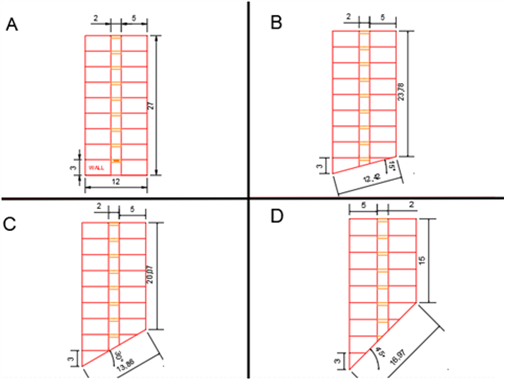
En la práctica estructural, es común suponer fundaciones rígidas al modelar estructuras, esta simplificación excluye los efectos reales de la interacción suelo-estructura (ISE), generando subestimaciones en la respuesta sísmica. Este estudio evalúa dicha interacción en edificios medianos fundados en muros de corte y ubicados en terrenos con pendientes de 0°, 15°, 30° y 45°, mediante análisis dinámicos no lineales en el software Seismostruct. Se aplicaron registros sísmicos chilenos reales (Angol, Valparaíso, etc.), incorporando modelos tipo “link” conforme al FEMA P-2091 para representar las rigideces dinámicas. Se analizaron desplazamientos, derivas de entrepiso y globales, esfuerzos cortantes y daño estructural. Los resultados muestran que la ISE y la inclinación del terreno influyen significativamente en la respuesta dinámica del sistema, especialmente en estructuras con alta rigidez lateras. Este estudio entrega recomendaciones prácticas para el diseño sísmico en zonas con topografía irregular, promoviendo una representación más realista del comportamiento estructural
Descargas
Referencias
Seismosoft, “SeismoStruct User Manual” Disponible en: https://seismosoft.com/ wpcontent/uploads/prods/lib/SeismoStruct-2022-User-Manual_ENG.pdf, 2025
FEMA P-2091, “Applied Technology Council for the Federal Emergency Management Agency, prepared”, FEMA P-2091, A Practical Guide to Soil-Structure Interaction, Disponible en: https://www.atcouncil.org/, 2020
F. D., Díaz, G. F., Espinoza, B. R., Sánchez Vergara, y C. I., Huerta López, “Respuesta dinámica de un edificio considerando el efecto de interacción suelo-estructura”, Monografía CIMNE IS-67, 2012
V., Anand & S. R., Satish Kumar, “Seismic Soil-structure Interaction: A State-of-the-Art Review” Structures, Vol. 16, pp. 317–326. Elsevier Ltd. https://doi.org/10.1016/j.istruc.2018.10.009, 2018
A. Soriano, “Interacción suelo-estructura. Modificación del movimiento”, Física de la Tierra, N 1, 1989
NIST, “Soil-Structure Interaction for Building Structures”, NEHRP Consultants Joint Venture A partnership of the Applied Technology Council and the Consortium of Universities for Research in Earthquake Engineering, 2012
M., Sadek, M.M., Hussein, F., Hage Chehade, & A. Arab, “Influence of soil–structure interaction on the fundamental frequency of shear wall structures”, Arabian Journal of Geosciences, 13. 2020
N., Allotey & M. H., El Naggar, “An investigation into the Winkler modeling of the cyclic response of rigid footings”, Soil Dynamics and Earthquake Engineering, 28(1), 44–57. https://doi.org/10.1016/j.soildyn.2007.04.003, 2008
A., Pais, & E., Kausel, “Approximate formulas for dynamic stiffnesses of rigid foundations”, Soil Dynamics and Earthquake Engineering, V 7, 4, 213-227, 1988
INE, “Diseño sísmico de edificios”, Norma Chilena Oficial, NCh 433.Of1996 Modificada, Instituto Nacional de Normalización, Santiago, Chile, 2012
INE “Diseño estructural- Cargas permanentes y cargas de uso”, Norma Chilena Oficial, NCh1537.Of2009, Instituto Nacional de Normalización, Santiago, Chile, 2009
INE “Diseño estructural Disposiciones generales y combinaciones de carga” Norma Chilena Oficial, NCh3171.Of2010, Instituto Nacional de normalización, Santiago, Chile, 2010
Descargas
Publicado
Número
Sección
Licencia
Derechos de autor 2026 Vicente Fuentealba Reyes, Juan Carlos Vielma Pérez, Edgar Giovanny Diaz-Segura

Esta obra está bajo una licencia internacional Creative Commons Atribución-NoComercial-CompartirIgual 4.0.
Las opiniones expresadas por los autores no necesariamente reflejan la postura del editor de la publicación ni de la UCLA. Se autoriza la reproducción total o parcial de los textos aquí publicados, siempre y cuando se cite la fuente completa y la dirección electrónica de esta revista. Los autores(as) tienen el derecho de utilizar sus artículos para cualquier propósito siempre y cuando se realice sin fines de lucro. Los autores(as) pueden publicar en internet o cualquier otro medio la versión final aprobada de su trabajo.


.png)