El arte del futuro de Arismendi o el despliegue de las fuerzas estético-terapéuticas en un caso de abstraccionismo digital
DOI:
https://doi.org/10.5281/zenodo.21987036Palabras clave:
abstraccionismo digital, arte del futuro, fuerzas estético-terapéuticas, Guillermo Arismendi, presencia mentalResumen
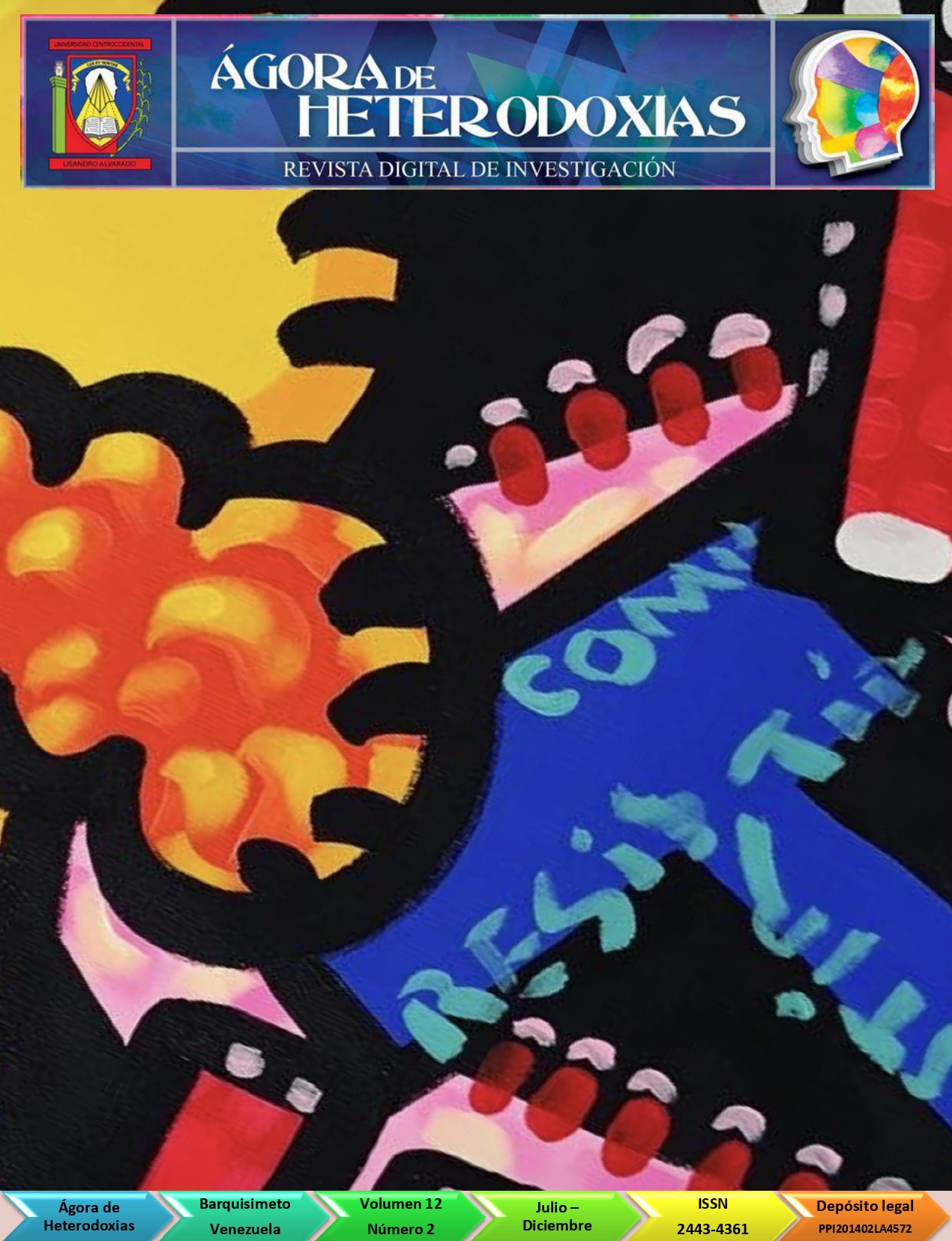
El artículo analiza dos obras digitales del artista visual español Guillermo Arismendi. Para ello, se recurre a la teoría de la complejidad de Edgar Morin y a las tesis sobre el arte del futuro de Peter Sloterdijk. Metodológicamente, se aplica el método de caso único junto con un muestreo de tipo teórico. Además, el estudio se plantea la hipótesis de que el abstraccionismo digital de Arismendi formaría parte de un posible arte del futuro, donde la configuración de un nuevo estado mental conduciría a percibir el arte como un enclave terapéutico-compensatorio. Los resultados confirman tal conjetura, sobre todo por medio de la concatenación observada entre los atributos de la pintura de Arismendi –complejidad composicional y cromatismo digital con predominio de la gama de azules- y un arte del futuro entendido como un arte de la impaciencia y de la complacencia inmediata. Precisamente, dicha concatenación es la que fomentaría en el arte del español el despliegue de las fuerzas estético-terapéuticas como signo de una presencia mental capaz de hacer frente a la complejidad y la barbarie poshistórica.
Descargas
Referencias
Arismendi, G. [@guillermo_arismendi]. (12 de mayo de 2025a). Homenaje a los olvidados (120525) #artwork #drawing #memorial #authentic #human #artgallery #kunst #handdrawn #originalart #artwork #freestyle #surrealist #nostalgic #improvisation [Imagen]. Instagram. https://www.instagram.com/p/DJkNVAroFq0/
Arismendi, G. [@guillermo_arismendi]. (04 de diciembre de 2025b). Sapphire Carving (250822) #artwork #painting #jazz #blue #jewelryoftheday #artgallery #joyas #humanmade #originalart #artwork #handpainted #dance #freehand #musical #abstractart #arteabstracto #instant [Imagen]. Instagram. https://www.instagram.com/p/DR2sjsJCMOS/
Artios Gallery (2026). Guillermo Arismendi. Painting / Digital art. https://www.artiosgallery.com/guillermo-arismendi
Barrios, B. (2015). Tres momentos críticos de la Teoría Fundamentada Clásica. Sapiens, 16(1), 31-47. https://ve.scielo.org/scielo.php?script=sci_abstract&pid=S1317-58152015000100003&lng=en&nrm=iso&tlng=es
Charmaz K. (2011). Grounded theory methods in social justice research. En: N. K. Denzin & Y. S. Lincoln (eds.). The Sage handbook of qualitative research. SAGE Publications.
Cleveland, K. (2018). Toda la verdad. Planeta
Fodor, J. (1986). La Modularidad de la Mente. Morata.
González, R. (2016). Dos criterios para la presencia de estados mentales: Descartes y Turing. Cinta de moebio, (56), 150-171. http://dx.doi.org/10.4067/S0717-554X2016000200004
Kant. E. (1992). Crítica de la facultad de juzgar. Monte Ávila.
Kennedy, C. H. (2005). Single-case designs for educational research. Pearson Education, Inc.
Körner, S. (1987). Kant. Alianza.
Morin, E. (2005). Introducción al pensamiento complejo. Gedisa.
Silenzi, M. (2009). El juicio estético sobre lo bello. lo sublime en el arte y el pensamiento de Kandinsky. Andamios, 6(11), 287-302. https://doi.org/10.29092/uacm.v6i11.161
Sloterdijk, P. (2020). El imperativo estético. Akal.
Stake, R. (2007). Investigación con estudio de casos. Morata.
Tillería, L. (2020). Crítica del “párergon”. Anales del Seminario de Historia de la Filosofía, 37(1), 37-44. https://doi.org/10.5209/ashf.62935
Valles, M. (2003). Técnicas cualitativas de investigación social. Síntesis.
Williamson, T. (2000). Knowledge and its Limits. Oxford University Press.
Descargas
Publicado
Número
Sección
Licencia

Esta obra está bajo una licencia internacional Creative Commons Atribución-NoComercial-CompartirIgual 4.0.
 Los autores mantienen los derechos para reutilizar el artículo para fines docentes y de investigación. Los lectores y usuarios pueden leer, descargar, copiar, distribuir, imprimir, buscar o usar sus publicaciones con cualquier propósito legal, sin ninguna barrera financiera, legal o técnica, además de las que son inherentes de las que implica acceder al Internet. Siempre y cuando preserven el derecho de los autores de ser adecuadamente reconocidos y citados Ágora de Heterodoxia no se hace responsable de la información suministrada por colaboradores, la cual no constituye, necesariamente, el punto de vista de la publicación.
Derechos del/de autor/es a partir del año de publicación

Esta obra está bajo la licencia:
Creative Commons Reconocimiento-NoComercial-CompartirIgual 4.0 Internacional (CC BY-NC-SA 4.0)